
The Rifle That Only Shoots Cold

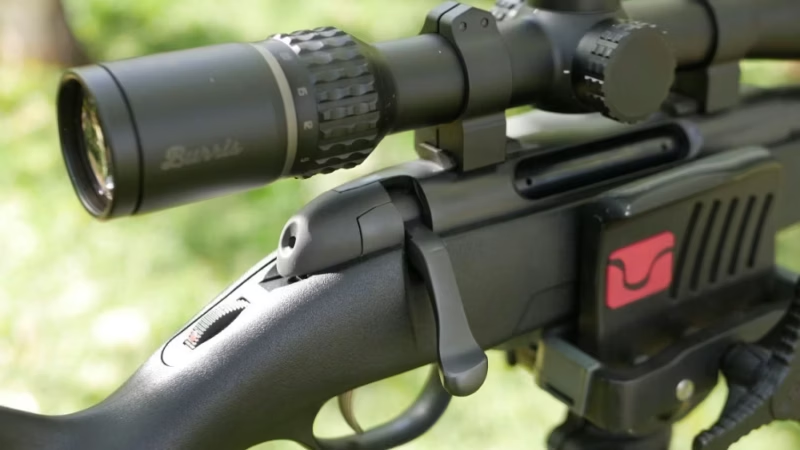
I spent more sessions than I want to admit trying to figure out what was wrong with my Steyr Pro Hunter.
The rifle is chambered in 30-06. Austrian made, tight tolerances, beautiful action. Not a common rifle in the United States, which is part of why I bought it. It has its own character. And for a while, that character frustrated me completely.
I was working up a handload. Standard process: set up at the bench, shoot a group, adjust, shoot again. Except something strange kept happening. Each shot during warmup was walking. Not randomly, but consistently: roughly three quarters of an inch per shot, climbing and drifting right, round after round as the barrel heated up. I kept thinking: what is going on with this thing.
Then the barrel got fully warm and the group pulled together. Tight, predictable, exactly what you want to see on paper.
Any other context, that would be a success. Load developed, rifle confirmed, go home. But I kept looking at those first shots walking across the target during warmup and something bothered me. That drift, that three-quarter-inch-per-shot pattern during heat buildup. That was not a range problem. That was a hunting problem.
Something Was Off. But Not What I Thought.
The thing about load development is that you can spend a long time solving the wrong problem.
Most reloaders treat the first shot or two as a warmup. You fire to foul the bore, let the barrel find its temperature, then start your real group. The shots that matter are the ones from a warm barrel. That is the standard approach and for most purposes it works fine.
The Steyr was showing me a different picture. Cold barrel, first shot: exactly where I was looking. Then each subsequent shot during warmup would walk about three quarters of an inch, drifting up and right as the barrel climbed in temperature. By the time the barrel was fully warm, the group would finally pull back together.
On paper that looks like a rifle that needs to warm up before it performs. The conventional conclusion would be: foul the bore, let it heat up, then trust your zero.
But that conclusion only makes sense if you plan to take your first hunting shot after the barrel is hot. And I have never once been in that situation on a real hunt.
The Moment It Clicked
At some point I stopped treating that cold bore first shot as a throwaway and started treating it as the only data point that actually mattered for hunting.
Cold barrel: perfect. Warming up: walking three quarters of an inch per shot. Fully hot: grouped again.
The Steyr was not broken. It was not fighting the load. It was telling me exactly what it was built for: one accurate shot from a cold barrel, the way every hunting shot actually happens. The warm-barrel performance was almost irrelevant. I was doing load development for a rifle I would never use in the field.
That was a useful thing to understand.
Learning to Wait
Once I understood what was happening, the whole approach to load development had to change.
No more shooting groups the conventional way. Instead: one shot, cold barrel, note where it landed. Then wait. Full cooldown. Not five minutes. Not ten. Until the barrel was genuinely cold to the touch. Then one more shot.
This takes time. Real time. A session that used to mean twenty or thirty rounds over an hour turned into five or six rounds over an entire afternoon. Shoot once, set the rifle down, go do something else, come back, shoot again.
It is not efficient. It is not exciting. It is exactly the kind of work that doesn’t look impressive at the range but matters completely when you are on a hillside in the dark waiting for enough light to shoot.
What I was building was not a load that grouped well after the barrel was warm. I was building a load that put the first cold shot exactly where I needed it. That is a different thing entirely. That is the only thing that matters for a hunting rifle.
What Cold Bore Actually Means
There is a technical reason why the first shot from a cold barrel behaves differently, and it is worth understanding even if you never go as deep into it as the Steyr made me go.
When a barrel is cold, the metal is contracted to its resting state. Any oil or solvent left in the bore from cleaning is still there, coating the rifling. The first bullet to travel down that barrel experiences a different environment than every bullet after it: different friction, slightly different pressure curve, different points of harmonic vibration as the barrel flexes during the shot.
Once the barrel heats up, the metal expands. The oil burns off. The barrel finds a new equilibrium. Shots two, three, four are going down a different barrel than shot one, in a meaningful physical sense.
For a varmint rifle or a bench gun, this is a minor inconvenience. You fire a fouling shot, let the barrel settle, and then shoot your groups. For a hunting rifle, that fouling shot is the deer. There is no warm-up round. There is no settling in. There is one moment and one shot, and whatever your rifle does from a cold barrel is what actually matters.
Some rifles are relatively indifferent to this. Others, like the Steyr, are specifically tuned for it. The tight tolerances and the action design favor that first shot. They are optimized for the conditions of an actual hunt, not for punching paper after a long warm-up sequence at the bench.
One Shot. That’s the Hunt.
The Steyr Pro Hunter taught me something that I thought I already knew but apparently needed to learn again the slow way.
Hunting does not give you a second chance to warm up. The animal does not wait while you get your barrel to operating temperature. The one moment you have is a cold barrel moment, every single time, and if your rifle and your load are not dialed in for exactly that condition, everything else you did at the bench was practice for a different sport.
Now when I work up a hunting load, cold bore performance is the only thing I am testing. Not groups off a warm barrel. Not how tight I can stack rounds after the metal is up to temperature. I test what the rifle does on the first shot, cold, clean, from the same conditions I will have in the field.
It takes longer. A lot longer. An afternoon of patient single shots with full cooldowns between them is not most people’s idea of a productive range session. But at the end of it, I know exactly what that rifle will do when the moment arrives. Not what it does when it’s comfortable. What it does when it counts.
That is what cold bore means. Not just a technical condition of the barrel. A standard for how you prepare. One shot, real conditions, no warm-up.
The rifle told me that. I just had to slow down enough to hear it.
Comments are closed.